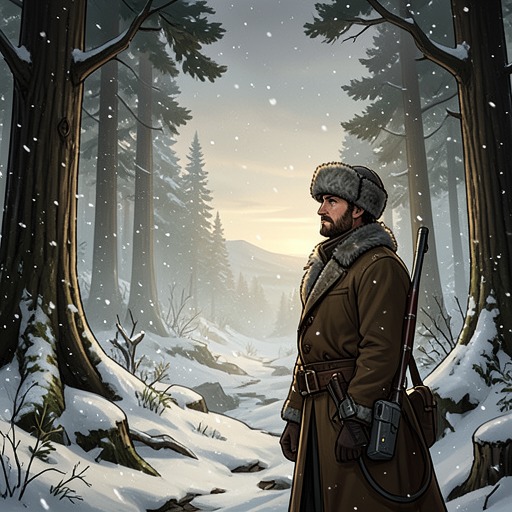
“The caribou feeds the wolf, but it is the wolf who keeps the caribou strong”
Never Cry Wolf“The caribou feeds the wolf, but it is the wolf who keeps the caribou strong” is both a traditional teaching and the central proposition in Ootek’s explanation of the relationship between Wolves and Caribou. Its force lies in reversing the familiar image of a predator as indiscriminate destroyer: the hunter depends on the herd, while its selective pressure is presented as helping preserve the herd’s strength.
Origin in Ootek’s Story
Ootek introduces the idea through a creation story from the inland people’s folklore. A Woman draws the animals out of a hole in the ground, with Caribou last; Kaila, the Sky God, declares it the greatest gift because it will sustain people. The Woman releases the Caribou to multiply, and her descendants hunt them for food, clothing, and the skins used to make tents.
The story then turns on what the people choose to kill. They hunt the fat animals, leaving the weak, sick, and small because those animals are less useful to them. In time, the weak and sick come to outnumber the strong. The Woman complains to Kaila that the Caribou are becoming unhealthy; Kaila answers that Amorak, the spirit of the Wolf, will instruct his children to eat the sick, weak, and small. Ootek’s closing maxim gives this tale its compact ecological logic: the Caribou feeds the hunter, whose predation in turn leaves the land to stronger animals.
The narrator recognizes the story as an account of survival of the fittest through natural selection, but that recognition does not immediately make him accept its claim. Ootek has presented the relationship as harmonious, while the narrator still imagines an intelligent, powerful predator free to choose the fattest prey. He points to skeletons of large, apparently healthy Caribou scattered near the cabin and across the tundra as what seems to him a direct objection.
How the Maxim Describes the Hunt
Ootek’s explanation is not that the hunters never attack healthy animals, but that they test the condition of a herd and generally pursue an animal that proves inferior. When Caribou are abundant, Wolves rush a band briefly to make its members flee; this exposes any sick, wounded, or otherwise weak animal. If one is revealed, they close in and try to kill it. If none is, they soon abandon the chase and move on to test another group.
When Caribou are scarce, the methods can become more coordinated. Several hunters may drive a small herd toward an ambush, or one may pursue deer toward another waiting at a distance, which then takes up the chase. Such relays reduce the herd’s advantage, but Ootek’s account still describes the least able animal as the usual victim. After a kill, the hunters do not immediately resume hunting: they stop until the food supply is gone and hunger drives them back to work.
The narrator’s later observations give the principle a visible pattern. In hunts he watches, groups of one to eight Wolves move at an unhurried trot among dispersed deer, which often appear unconcerned. A wolf or a small group makes a short dash; the deer may wait until the pursuers are about a hundred yards away before galloping off. If they run well and appear in good condition, the hunters stop and watch them go. The narrator also notices that prime bucks, then at peak condition after a summer of feeding and resting, are seldom tested—not because their antlers make them formidable opponents, but because the Wolves cannot catch them. Herds of females with fawns attract more attention because a greater share of the young have not yet passed through prolonged natural selection.
Evidence, Scope, and Meaning
The saying expresses a principle of selective predation, not a claim that Caribou are the only food or that every encounter ends in a kill. Elsewhere, the narrator discovers that Wolves at Wolf House Bay can live largely, perhaps almost entirely, on mice while raising families outside the summer Caribou range. Ootek adds ground squirrels and fish to the account of their diet: he has watched Wolves catch Northern pike in narrowing marsh channels and take spawning suckers from shallow streams. These examples place the maxim within a wider food web and show how the hunters’ sustenance can vary with available prey.
The narrator’s evidence also comes from different kinds of observation. He witnesses the repeated pattern of pursuit and abandonment in the Caribou herds, while Ootek supplies knowledge of techniques and behavior the narrator has not himself seen. The distinction matters: the maxim is not proved by a single dramatic kill, but developed through a traditional explanation, practical knowledge, and recurring field observations. The narrator’s earlier appeal to scattered skeletons does not by itself establish which animals were killed or under what circumstances; his subsequent observations instead clarify the selection process Ootek describes.
The phrase’s memorable balance—one animal feeds the other, and the other keeps it strong—makes ecological dependence sound reciprocal rather than merely adversarial. It does not erase predation: the hunters kill Caribou, and the herd supplies their food. But it changes the emphasis from slaughter without limit to a relationship shaped by testing, pursuit, and restraint when the deer prove fit. The narrator begins skeptical of that account; the repeated sight of hunters turning away from strong runners gives the saying the evidence that the parable alone could not provide.